How high should you hang a curtain rod?
Most guides say 4 to 6 inches (10 to 15 cm) above the frame (Bob Vila, Homes & Gardens), and Homes & Gardens sets 2 inches (5 cm) as the minimum. A rod above the frame pulls the eye up and stretches the window, so the ceiling looks higher too.
Past that, sources differ. SelectBlinds allows up to 12 inches (30 cm). Designer Noelle Isbell, in Homes & Gardens, goes to just shy of the ceiling to make a room feel taller.
- Plenty of wall above. Start at 4 to 6 inches.
- Under about 12 inches (30 cm) to the ceiling. Homes & Gardens suggests halfway between frame and ceiling. A thin strip of wall left above a rod looks like a mistake.
- Ceilings of 10 feet or more. Bob Vila suggests staying within 8 inches (20 cm) of the frame, so the rod still looks attached to the window.
How far past the window should the rod extend?
Far enough that open curtains clear the glass. Bob Vila says 3 to 6 inches (8 to 15 cm) or more per side, Homes & Gardens up to about 12 inches (30 cm), and This Old House 8 to 15 inches (20 to 38 cm) for the most daylight.
The reason is stack-back, the bundle of fabric at each end when the curtains are open. Houzz puts it at 10 to 15 percent of panel width for light unlined curtains and 20 to 25 percent for heavy lined ones. Stop the rod at the frame and that bundle covers the glass and narrows the window, so heavy drapes need the wider end.
How wide should curtain panels be?
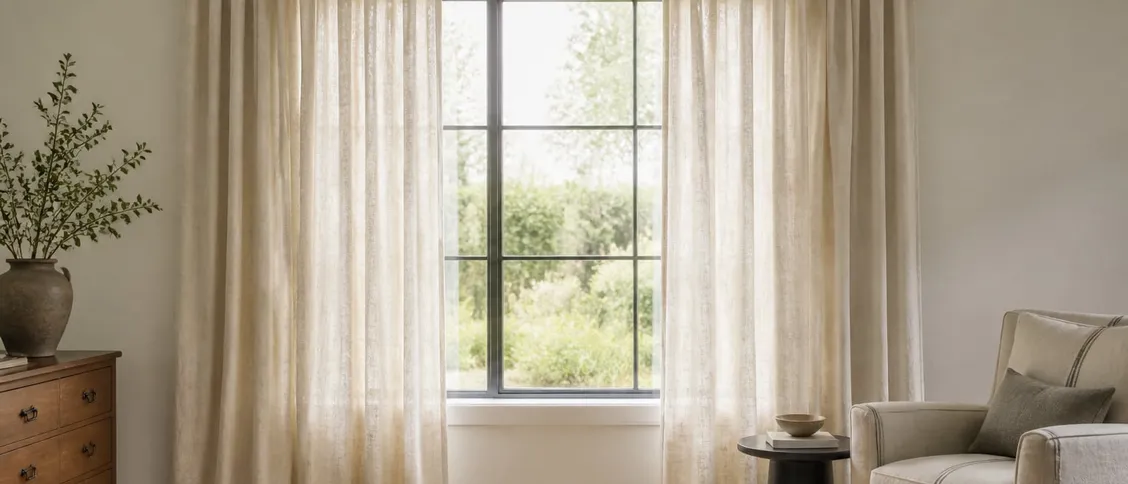
Wider than the rod, or they hang flat instead of in waves. Guides call this fullness: total panel width divided by rod width, extensions included. Noelle Isbell calls 2 times the industry standard, and Houzz calls 2.5 times typical.
| Heading | Fullness | Why |
|---|---|---|
| Pinch pleat and other pleats | 2 to 2.5 times | Pleats use up fabric at the top |
| Grommet or rod pocket | About 1.5 to 2 times | The top gathers on the rod by itself |
| Sheers | About 3 times, up to 3.5 | Thin fabric only looks full when gathered |
Linen Chest calls 2 times standard for pleated drapery and rates grommets for low to medium fullness. For sheers, Houzz suggests tripling, and designer Kiley Jackson uses 3 to 3.5. Treat rod pockets like grommets, since few guides give them a figure. Ready-made panels are usually 48 inches (122 cm) wide (Homes & Gardens), so wide windows need more of them.
Should curtains touch the floor?
In most rooms, yes or nearly. The choice is how the hem meets the floor.
| Length | Where the hem sits | Best for |
|---|---|---|
| Float | 1/4 to 1/2 inch (6 to 13 mm) above the floor | Curtains you open daily |
| Kiss | Just touching the floor | A crisp look that still slides |
| Break | About 1 to 2 inches (2.5 to 5 cm) extra | A relaxed look, rarely moved |
| Puddle | 1 to 3 inches extra, up to 6 to 12 inches (15 to 30 cm) | Formal rooms, panels that stay put |
| Sill | Just above the sill or a little below | Kitchens, bathrooms, radiators, kids' rooms |
Sources overlap at the edges, so read the rows as a scale. Kelly Simpson of Budget Blinds warns in Homes & Gardens that puddles can trip people and collect dust. Around pets, toddlers or a robot vacuum, float or kiss.
How do you measure a window for curtains, step by step?
- Mark the rod height above the trim with a level.
- Set the rod length: frame width outside the trim, plus the same extension each side.
- Put up the brackets or rod first. Every number comes from the rod.
- Work out panel width: rod length times fullness, divided by the number of panels.
- Measure length from the right point (Homes & Gardens): grommets from the rod top plus the fabric above the grommet, rod pockets from the rod top plus 1/2 inch, pleats hanging below the rod from its bottom.
- Measure both ends and the middle. Floors are rarely level, so order the longer number (SelectBlinds).
- Adjust for the look: subtract for a float, add for a puddle.
- Round up. Ready-made lengths commonly run 63, 84, 95 or 96, 108 and 120 inches (160 to 305 cm). Take the longer one and hem it.
A worked example. The trim top is 80 inches from the floor and the frame is 36 inches wide. A rod 5 inches up sits at 85 inches, and 6 inches per side makes it 48 inches long. Two grommet panels at 2 times fullness are 48 inches each. Kissing the floor takes about 85 inches plus the grommet allowance, so buy 95 or 96 inch panels and hem them.
| Measurement | Common range | Why |
|---|---|---|
| Rod above frame | 4 to 6 in (10 to 15 cm), up to 12 in or the ceiling | Draws the eye up |
| Rod past frame, each side | 3 to 12 in (8 to 30 cm) | Stack-back clears the glass |
| Fullness, pleated | 2 to 2.5 times the rod | Pleats use fabric |
| Fullness, grommet | 1.5 to 2 times the rod | Top gathers itself |
| Fullness, sheers | About 3 times the rod | Thin fabric needs volume |
What makes curtains look wrong, and which mistake can't be fixed?
Too short is the one you can't undo. You can hem a long panel but you can't add fabric, and lowering the rod gives up the height you wanted. Everything else can be put right:
- Rod on the frame or stopping at its edge. The window shrinks and open curtains cover the glass. Move the brackets or buy a longer rod.
- Panels too narrow. One 48 inch panel per side on a wide window hangs flat. Add panels.
- Length measured from the window, not the rod. It misses the gap above the frame.
- No centre support. This Old House says rods over 4 feet (1.2 m) may need a centre bracket, screwed into studs or wall anchors.
Short, low curtains are a usual suspect when a room feels off. Renting? See decorating a rental without risk before you drill.
Sheer, blackout or layered: which suits which room?
- Bedrooms: blackout. Closed blackout curtains block virtually all light (Bob Vila). A wider rod stops leaks at the sides.
- Living rooms: sheers, alone or under lined panels. Sheers filter light without weighing the room down (Houzz).
- Kitchens, bathrooms, kids' rooms, radiators: sill length. Homes & Gardens suggests it where long drapes get wet, pulled or block heat.
- Cold or sunny windows: lined. The Department of Energy says to close curtains on winter nights and against direct summer sun.
To compare sheers, lined panels or a Roman shade first, the Curtains and shades tool in the Revamp AI app shows them on your own windows from a photo. It is an AI preview of the style, not a measurement.
When are blinds or shades the better answer?
When the window is small, damp or drafty. Bob Vila notes that slats give finer light control and wipe clean, while fabric can mold in kitchens and bathrooms.
Blinds usually cost less. Bob Vila's 2025 update, citing Angi, puts eight windows of blinds at about $280 to $800 installed and curtains at about $440 to $3,200. Use marketplace ranges like these to check a quote.
For drafts, cellular shades are the energy pick. A 2021 Department of Energy fact sheet says lab simulations found they save more energy than any other shading type, and that window attachments can save 15 percent of a home's yearly heating and cooling energy compared with vinyl blinds.