Start with the roof, brick and stone you are keeping
The roof decides more of your palette than the fan deck does. Benjamin Moore says to build an exterior palette from "unchanging exterior elements like roofing, stone, brick and landscaping". Paint is the cheap, changeable layer. The shingles and brick will outlast the next two repaints.
Owens Corning, which makes shingles, sorts it simply: reds, yellows and oranges are warm, blues, greens and violets are cool, and even neutrals lean one way. Mix the two and "something will just look off", it warns. James Hardie gives the same rule for siding: warm with warm, cool with cool.
| What you are keeping | Usually reads as | Start the body color in |
|---|---|---|
| Shingles with brown, tan or red granules | Warm | Warm whites, creams, warm grays, earthy greens |
| Blue gray or slate shingles | Cool | Crisp whites, cool grays, gray blues |
| Red or orange brick | Warm | Creams and warm neutrals |
| Gray stone or gray brick | Cool | Off whites and lighter grays |
| Black roof or black windows | Neutral | Either family, so let the brick or stone decide |
Then look at the street. Benjamin Moore advises colors that suit the house's style, its setting and the neighborhood. If you have an HOA or live in a historic district, read the color rules before you buy any paint.
Pick a body, a trim and an accent color
Benjamin Moore says homeowners "typically use three to four colours" on an exterior. Each one has a job.
- Body. The siding or stucco. It covers most of the house, so choose it most carefully.
- Trim. Window casings, fascia, corner boards. It outlines the shape of the house.
- Accent. The front door or shutters. It is the smallest area, so it is the safe place for a strong color.
This Old House describes the classic version: light neutral walls, white trim and a dark accent such as shutters. If you are torn between a bold body and a bold door, put the boldness on the door. A door is a weekend to repaint. Siding is thousands of dollars.
Check the undertone before you fall for a chip
An undertone is the hidden color under the obvious one: the green in a gray, the pink in a beige. Brick and Batten's rule is to pick colors whose undertones don't clash. A blue gray body against brown shingles is the classic scheme that looks wrong when nobody can say why.
To see an undertone, compare. Hold the chip next to others from the same family, or against plain white paper, and notice which way it drifts. Then hold it against the brick or a spare shingle.
Why the same color looks different on your house
Outdoor light is stronger and changes more than store light. Benjamin Moore notes that a color in shade looks darker than in direct sun, and that the direction a house faces changes how its paint reads. A north wall sits in soft, cool light. A south or west wall gets strong sun that can wash a pale color out.
Surroundings reflect onto the walls too. A lawn, a big tree or a neighbor's red brick all tint your siding a little. That is why the only test that counts happens outside.
What LRV means, and why dark colors need care
Light reflectance value, or LRV, is how much light a color bounces back. Sherwin-Williams describes the scale as 0 (absorbs all light) to 100 (reflects all light) and prints it on the back of its chips. Low numbers are dark, high numbers are pale.
Outside, LRV is also a heat number. Dunn-Edwards' technical bulletin says darker colors absorb more heat, which can break down the paint binder faster and show as discoloration or loss of gloss. Dark colors can also cure more slowly and blister more, especially in direct sun. Higher LRV colors stay cooler.
Vinyl siding has a stricter limit. Sherwin-Williams says vinyl that warps after a repaint was most likely painted darker than its original color, and advises staying no darker than the original unless you use a paint made for vinyl, such as its VinylSafe colors, on sound, stable siding. It gives no LRV cutoff, so ask your paint store.
None of this rules out a navy house. It means a dark body needs better paint, careful prep and maybe an earlier repaint on the sunny walls.
How to test exterior paint samples properly
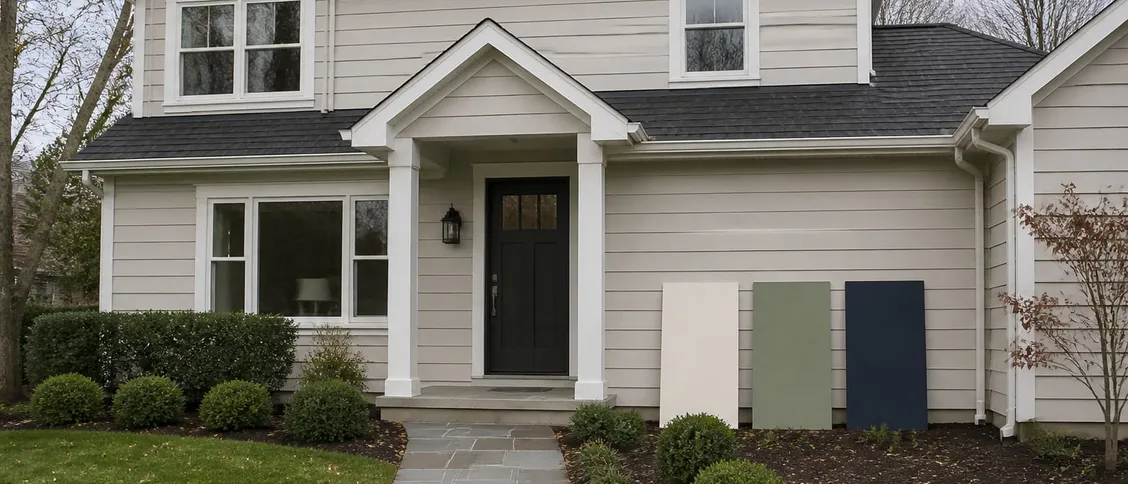
Test big, outside, over a full day. Benjamin Moore says its sample pots are made for interior use and suggests painting exterior samples on white foam board instead of the house. One 8 oz pot covers about a 2 by 2 foot area in two coats, a good board size.
- Narrow to two or three body colors. More than that and they blur together.
- Paint two coats. One coat lets the white board show through.
- Prop boards against the house, next to the trim color and the brick or stone.
- Use the sunniest and the shadiest wall. Those are your two extremes.
- Look morning, noon and evening, and on a cloudy day if you can.
- Judge from the curb, the way everyone else sees the house.
You can narrow the list before buying boards. Revamp AI's Exterior redesign tool lets you photograph your house and reimagine the facade with new colors, a new front door and fresh trim. Use it as an AI preview to cut ten options to three; screens do not show true paint color, so the final pick still happens on a board outside. A straight, well lit photo helps, just as it does for a room.
What a repaint costs and how long it lasts
This Old House's cost guide (updated March 2026) puts a professional US exterior repaint at about $2.20 to $4.40 per square foot, or $4,400 to $8,800 for a 2,000 square foot home. CertaPro, a painting franchise, reports a $5,477 average for its own jobs over the past year, with 1,500 to 2,500 square foot homes usually $5,000 to $10,000. Stories, prep and region move it a lot.
This Old House gives standard exterior latex about five to seven years and premium 100 percent acrylic eight to 12 years or longer. Whatever you pick will likely be up for most of a decade.
How to decide
- List what stays (roof, brick, stone, windows, driveway) and mark each warm, cool or neutral.
- Choose the family: warm with warm, cool with cool.
- Pick body first, then trim, then accent. The body has the least room for mistakes.
- Check undertones and LRV. On vinyl, stay no darker than the original unless the paint is made for it.
- Check HOA or district rules before buying paint.
- Test two or three finalists on boards, two walls, three times of day.
- Choose the one you still like on a cloudy evening. Sunny noon flatters everything.
If two finalists still tie, pick the one closer to the roof's undertone. The roof is what it will sit next to for the next eight years.