What does each floor cost per square foot, installed?
LVP (luxury vinyl plank, a printed plank under a clear wear layer) is usually the cheapest. Wood and tile overlap so much that the product matters more than the category. These US figures come from contractor cost guides, which earn from leads, so use them to sanity check quotes.
| Floor | This Old House (June 2026) | Fixr (January 2025) |
|---|---|---|
| Luxury vinyl plank | $3 to $10 material plus $3 to $10 labor | $3 to $16, most pay $5 to $12 |
| Engineered hardwood | $6 to $23 | $8 to $14 |
| Solid hardwood | $5 to $28 | $9 to $23 |
| Ceramic tile | $11 to $39 | No per-foot figure; $800 to $4,500 for 200 sq ft |
| Porcelain tile | $13 to $48 | $2,000 to $4,400 for 200 sq ft (about $10 to $22) |
The sources disagree most on tile. Inch Calculator puts porcelain and floor-rated ceramic at $9 to $25 installed, well below This Old House. Labor is the swing factor: Fixr quotes $7 to $14 per square foot just to lay porcelain.
This is general cost information. Removing the old floor, subfloor repair and local labor rates can push a quote outside these ranges, so get three local bids.
How long does each floor last, and can it be refinished?
Solid hardwood lasts longest because you can sand it back to bare wood and start again. This Old House gives hardwood a 50 to 100 year lifespan and puts professional sanding and refinishing at $3 to $8 per square foot, the same range Fixr gives (Fixr's average is around $5).
- Solid hardwood. The National Wood Flooring Association (NWFA) says it can be sanded and refinished many times. Most scratches sit in the finish, so a light recoat often fixes a dull floor.
- Engineered hardwood. A real wood top layer over plywood layers. NWFA says it usually can be refinished, but not always as often as solid; Fixr says five to six times. The wear layer decides: NWFA's refinishable certification requires at least 2.5 mm on factory-finished boards, so ask for that number.
- LVP. It can't be sanded or resurfaced. This Old House says a well-installed vinyl plank floor can last around 20 years. Damaged planks get replaced, easy with click planks if you kept a spare box.
- Tile. This Old House says tile can last 50 years with care, or up to 20 in heavy traffic. A cracked tile can be cut out and replaced, but only if you kept spares from the same batch.
Which floor handles water, scratches and pets best?
Tile wins on water, LVP is close behind for spills, and wood needs protecting. Read "waterproof" on vinyl boxes carefully.
The COREtec Galaxy waterproof warranty (revision dated August 2021) covers topical moisture "as long as the water does not flow over the edge of the surface" and excludes floods and subfloor moisture. A spilled pot is fine. A dishwasher leak running under the planks for a week is not covered.
- Wood and water. This Old House lists humidity and moisture damage as a hardwood weakness and says engineered moves less with humidity than solid. NWFA recommends keeping the home at 30 to 50 percent humidity and 60 to 80°F year round to limit gaps in winter and swelling in summer.
- Scratches and pets. NWFA's homeowner handbook says wood floors handle pets, but scratches will happen, mostly in the finish, and are usually easy to repair. It advises rugs at doors and trimmed nails.
- LVP wear layer. Bob Vila's vinyl brand guide treats 12 mil as the line between home and light commercial use and 20 mil and up as commercial. With a large dog, I would not buy below 12 mil, and 20 mil is worth the extra if the budget allows.
- Tile. Fixr describes porcelain as denser and harder than ceramic, so it is less likely to chip. Grout and cracked tiles are the usual issues.
How do they compare on comfort, noise and resale?
Comfort is where tile loses. It is hard and cold underfoot, which is why people who cook a lot keep a cushioned mat at the sink. Wood and vinyl both have a little give.
Noise is about what's underneath. This Old House notes hardwood can tap and creak, says solid wood muffles noise better than thinner engineered boards, and suggests underlayment for thinner vinyl at about 50 cents per square foot. Ask the installer what goes under a floating floor.
Resale data favors wood. In the NAR and NARI 2022 Remodeling Impact Report, refinishing hardwood cost an estimated $3,400 and Realtors expected $5,000 back at sale, a 147 percent recovery, the highest of any interior project. New wood flooring cost $5,500 with $6,500 expected back, 118 percent. The report has no line for vinyl or tile, and This Old House says vinyl's return is lower than other floor types.
If you already have hardwood under carpet or a worn finish, refinish it first. In the NAR figures it recovers more of its cost than new wood does.
Which floor suits a kitchen, living room or basement?
Match the floor to the worst thing that will happen in the room, not its best photo.
| Floor | Best rooms | Can it be renewed? | Main weak spot |
|---|---|---|---|
| Luxury vinyl plank | Kitchens, basements, busy family rooms, rentals | No, replace planks | Lower resale return, thin wear layers scuff |
| Engineered hardwood | Living areas, open plans, basements | Sometimes, depends on wear layer | Water left standing |
| Solid hardwood | Living and dining rooms on or above ground | Yes, many times | Humidity swings and spills |
| Porcelain or ceramic tile | Kitchens, entries, laundry, bathrooms | Replace single tiles | Cold, hard, grout upkeep |
Basements are the clearest call. NWFA says solid wood belongs on or above ground, while engineered is suitable for any level, including basements. In a kitchen, all four can work if you match them to the water you expect.
What do people regret most after new floors go in?
Most regrets are about how the floor looks and wears in the actual room. Four come up again and again.
- Choosing by look alone. A floor that suits the photo may not suit the room. Livingetc's flooring mistakes piece puts ignoring the room's function first, such as glass mosaics in a kitchen.
- Glossy finishes. NWFA says the less sheen a floor has, the less you notice small scratches and normal wear. Shaw is blunter: the higher the gloss, the more you see marks, scuffs and scratches, and low gloss suits high traffic. Matte or satin is the safer call for a kitchen with a dog.
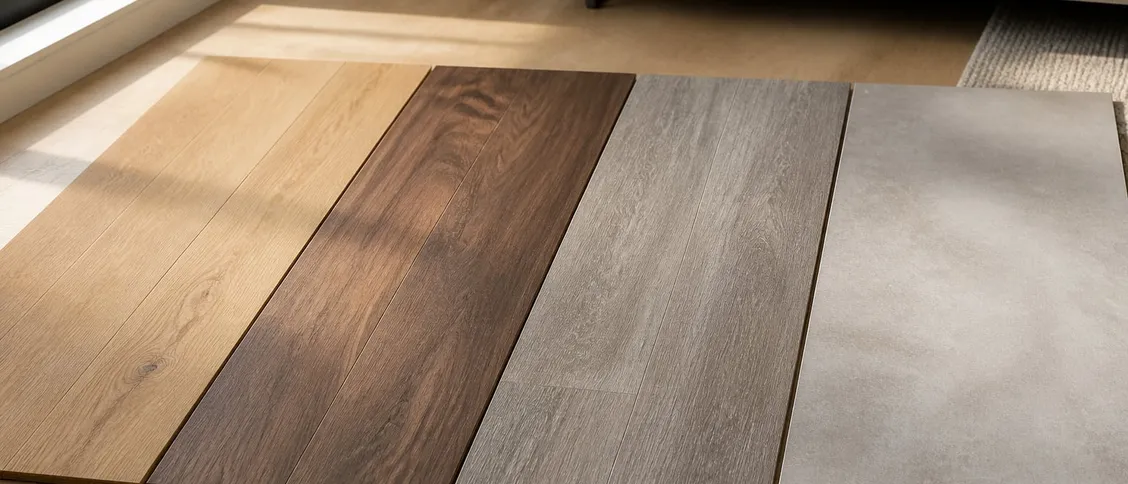
- Skipping samples in the real room's light. Floor & Decor advises checking samples in your own natural and artificial light, at different times of day, because color and detail shift. Leave big samples down for a few days, by the window and in the darkest corner.
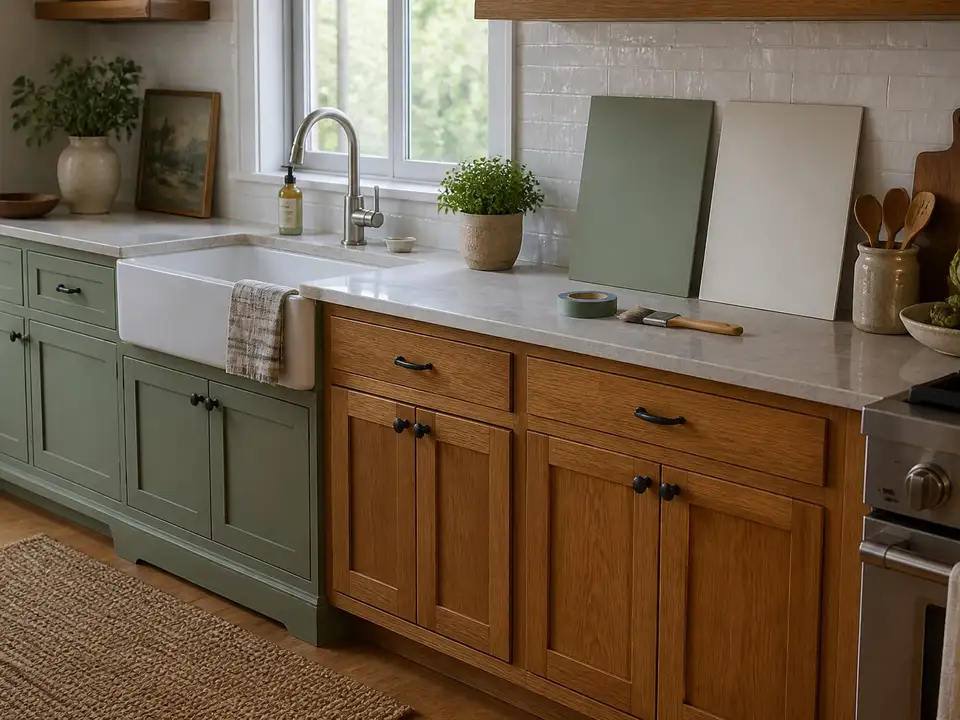
- Undertones that clash with walls and cabinets. Sherwin-Williams says to pair warm wall colors with warm floors and cool with cool, and calls an icy gray wall over golden yellow flooring a clash. Its trick: put bright white paper next to the floor sample to see whether it leans warm or cool, then hold the sample against your cabinet doors.
If a room already feels a little wrong, why your room feels off covers the usual causes.
How do I decide which floor to buy?
Answer these in order.
- How wet does this room get? Regular spills, a dishwasher, kids, a dog bowl: tile or LVP. Occasional spills wiped up quickly: any of the four.
- Is it below grade? Then rule out solid hardwood, which NWFA limits to on or above ground. Engineered, LVP or tile.
- How long will you stay? Ten years or less, or a rental: LVP is hard to beat on cost. Twenty years or more: wood or tile, because you can renew or repair them.
- Who walks on it? Big dogs mean a 12 to 20 mil LVP wear layer, tile, or wood with a matte finish you accept will mark.
- What can you spend, all in? Price the whole job, removal and subfloor included.
- Does the color survive your room? Order large samples and live with them for a few days next to the cabinets and walls.
If you want to see a material on your own floor before ordering samples, Revamp AI's Floor design tool lets you try hardwood, tile, stone or carpet on a photo of your real floor and compare them side by side. It is an AI preview to narrow the choice, not a guarantee of the finished look, so still check real samples. See how to photograph a room for an AI redesign.