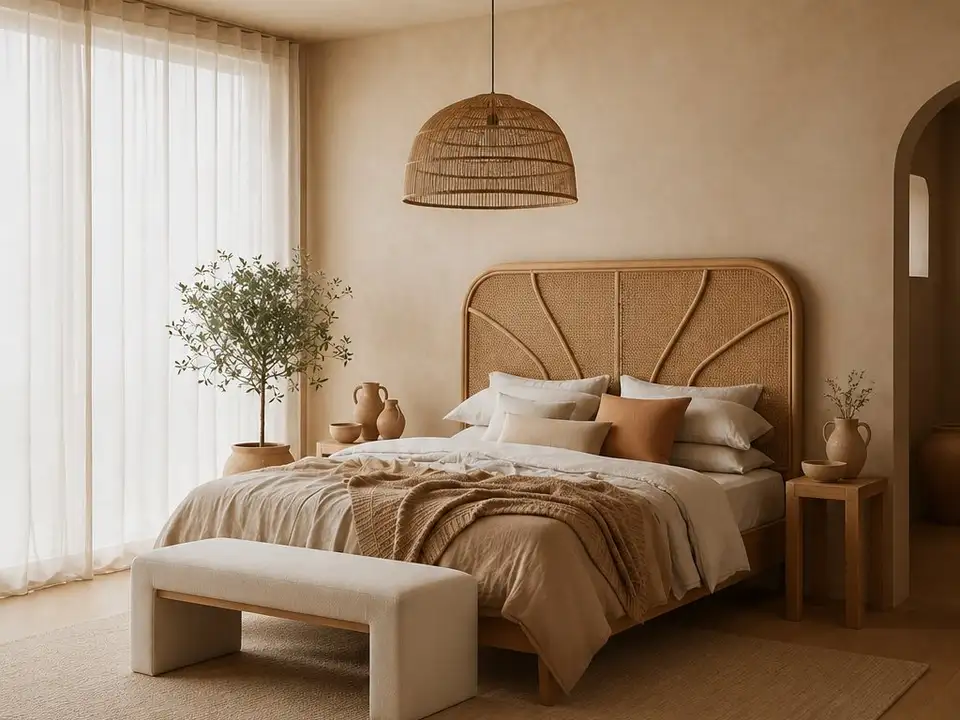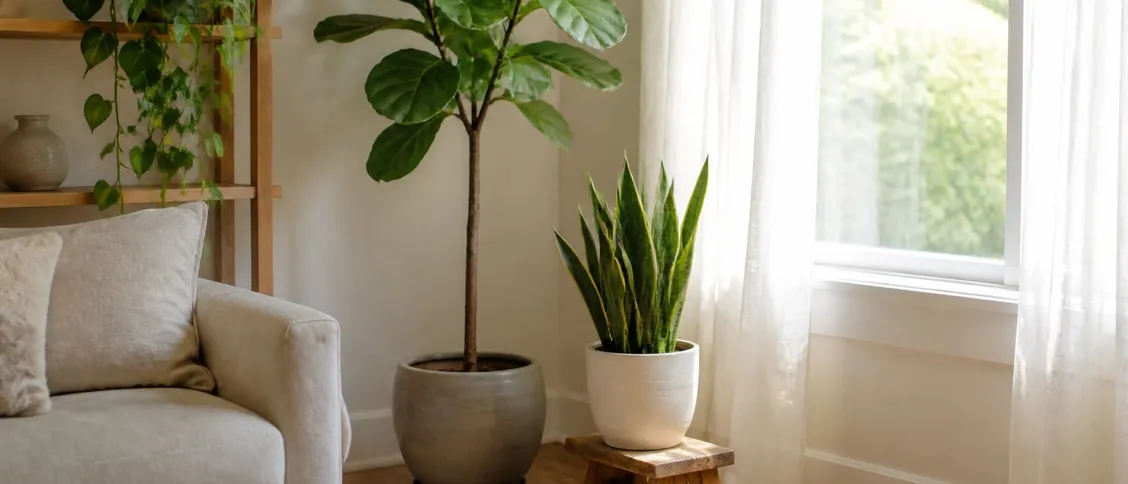
How much light does the spot really get?
Light is the one thing you can't water your way around. It comes down to window direction and distance from the glass.
- South. The brightest window in the Northern Hemisphere, says University of Missouri Extension. Low-light plants can burn there in summer.
- East and west. Medium to bright. East gets morning sun, west afternoon sun.
- North. The dimmest. University of Maryland Extension files it under low light.
In the Southern Hemisphere, swap north and south. East and west stay the same.
Distance matters as much. Missouri Extension notes that even low-light plants usually starve more than 10 feet from an average window. Illinois Extension puts high light within about 5 feet of a south window, medium at 3 to 10 feet and low at 15 to 20.
What do bright indirect, medium and low light mean?
Extension services measure these tag words in foot-candles (fc). One foot-candle is about 10.8 lux.
| Tag says | UF/IFAS and Maryland | Missouri | Typical spot |
|---|---|---|---|
| Low | 25 to 100 fc | 50 to 250 fc | Far from windows, or at a north window |
| Medium | 100 to 500 fc | 250 to 1,000 fc | Near a window with no direct sun |
| Bright indirect or high | 500 to 1,000 fc | 1,000 fc and up | Near an east or west window, or a shaded south one, any sun softened by a sheer |
The sources disagree, so read these as bands. For scale, Maryland Extension puts peak outdoor sun at about 10,000 fc.
Your eyes adjust to dim rooms, so check instead:
- Shadow test. On a sunny day, hold your hand about 1 foot above white paper at the spot. A sharp shadow means bright light, a fuzzy but recognizable hand means medium, and a faint blur with no fingers means low. Repeat it in winter, when the same spot gets much less.
- Phone light meter app. UF/IFAS says apps are useful mainly for rough numbers and spotting changes. Compare spots at midday rather than trusting one figure.
What changes in a bathroom, kitchen, bedroom or windowless room?
A windowless room has no light, which is not the same as low light. As Homes & Gardens puts it, no plant survives in no light at all.
- Windowless room. Use a grow light on a timer. Missouri Extension says plants with no outdoor light need 16 to 18 hours a day, and the RHS suggests about 16 hours with tubes around 2 feet (60 cm) above the plants. Or rotate: keep two of the same plant and swap them with a bright room regularly (a common workaround, not a tested schedule).
- Bathroom. Penn State Extension notes the humidity depends on how often the shower runs, and bathrooms often lack light. A bright one suits ferns, not cacti.
- Kitchen. The risk is heat and drafts. Maryland Extension warns plants are sensitive to heat registers and air conditioning, so keep them clear of the oven and vents.
- Bedroom. Maryland gives 60 to 68°F at night and 70 to 80°F by day as best for foliage plants. Keep pots off radiators and cold winter glass.
Winter is the dry season indoors. Penn State says humidity can fall below 30 percent with the heat on, and that daily misting does nothing to raise it around a plant.
What size plant suits the space?
Buy for the size the plant will reach. NC State Extension says a fiddle leaf fig grows 2 to 10 feet tall as a houseplant, and rubber plants are usually kept at 2 to 10 feet with pruning. Under an 8 foot ceiling, the top of that range means cutting it back.
One large floor plant usually looks better than a scatter of small pots, which read as clutter. If you love small plants, group them so they act as one shape.
Proportion is about neighbors. The RHS gives the example of a tiny cactus beside a giant weeping fig, where each makes the other look wrong. Pair a big plant with a sofa or bookcase, a small one with a side table. A plant can also balance a lopsided room, one of the checks in why your room feels off.
Which plants will live in which light?
Pick two or three that match your spot. Ratings and indoor sizes come from Illinois, Maryland, Missouri and NC State Extension, which don't always agree.
| Light | Plant | Indoor size | Note |
|---|---|---|---|
| Low | ZZ plant (Zamioculcas zamiifolia) | 2 to 4 feet | Water when the soil dries out |
| Low | Snake plant (Dracaena trifasciata, sold as Sansevieria) | Leaves up to 4 feet, dwarf types a few inches | Hates overwatering |
| Low | Cast iron plant (Aspidistra elatior) | 1 to 3 feet | Dislikes direct sun |
| Low | Parlor palm (Chamaedorea elegans) | Up to 5 feet, usually less | Happier in brighter light |
| Low | Peace lily (Spathiphyllum) | 8 inches to 3 feet, by type | Wilts when dry |
| Low to medium | Pothos (Epipremnum aureum) | Trailing vine | Fades to plain green in deep shade |
| Medium | Spider plant (Chlorophytum comosum) | 1 to 1.5 feet tall | Shelf or hanging basket |
| Medium to bright indirect | Rubber plant (Ficus elastica) | 2 to 10 feet with pruning | Shield from afternoon sun |
| Medium to bright indirect | Fiddle leaf fig (Ficus lyrata) | 2 to 10 feet | Direct sun scorches leaves |
| Bright | Cacti and succulents | Varies | Water less in winter |
Why do most houseplants die?
Too much water, then the wrong light. Maryland Extension names overwatering as the top killer: roots need air as well as water, and soggy soil rots them. Use pots with drainage holes.
Wrong light kills more slowly, and it feeds the first problem: a plant in dim light drinks less, so the soil stays wet.
Which houseplants are safe for cats and dogs?
Check every plant on the ASPCA toxic and non-toxic plant list by its botanical name. Common names overlap: the ASPCA lists "fiddle-leaf" as a name for a philodendron, not the fig.
- Toxic to dogs and cats (ASPCA). Golden pothos (Epipremnum aureum), peace lily (Spathiphyllum) and philodendron (Philodendron bipennifolium) contain insoluble calcium oxalates. For the first two, the ASPCA lists mouth burning, drooling, vomiting and trouble swallowing. Snake plant (Sansevieria trifasciata) contains saponins and causes nausea, vomiting and diarrhea.
- Non-toxic to dogs and cats (ASPCA). Spider plant (Chlorophytum comosum), parlor palm (Chamaedorea elegans) and Boston fern (Nephrolepis exalta bostoniensis). Clemson Extension adds African violet, moth orchid, peperomia and hoya.
The ASPCA says its list is not complete. If a pet eats a plant, call your vet or ASPCA Animal Poison Control at (888) 426-4435 right away. A fee may apply. This is general information, not veterinary advice.
How do I decide what to buy?
- Note the window direction and the distance to the spot.
- Do the shadow test at midday on a sunny day.
- Name the light level. No window means a grow light.
- Check the room for steam, heat from an oven or vent, and cold glass.
- Size it to the furniture and ceiling using the mature size.
- Pick two or three species from the matching rows and check them on the ASPCA list.
- Water by touch, not by calendar.
For a starting list, Plants for my room in the Revamp AI app lets you photograph a room and see which plants suit it, where each would go and how much light it needs. It is an AI suggestion from one photo and cannot measure light, so check the spot yourself. For a clear shot, see how to photograph a room.