Interior Design Styles Guide: 20 Looks, What Makes Each One Distinct, and How to Test Them on Your Room
There are roughly 20 interior design styles that come up repeatedly in search results, Pinterest boards, and designer consultations. Most articles list them the same way: a photo, a label, and a vague description that could describe three other styles. This guide does something different. For each style, you get three things: what makes it unmistakably that style, what it is often confused with, and who it actually suits. Not mood boards. Not aspirational copy. A reference you can actually use.
How to Actually Use This Guide
Skim all 20 entries first. You are not reading for depth on this pass — you are looking for the three or four that make you stop. Then go back and read those carefully. By the end, you will have two or three real candidates. The next step is not a mood board or a quiz. It is uploading a photo of your actual room to Revamp AI, applying each candidate style to it, and letting your gut reaction to your own room settle the question. That reaction — not a personality quiz, not a stranger's Pinterest board — is the only reliable data point.
The 20 Interior Design Styles
Modern / Contemporary
Modern design means clean lines, a neutral palette anchored by one warm accent, and a deliberate absence of ornamentation — every element is there because it serves the composition, not because it fills space. It is often confused with Minimalism, but they are not the same: Modern still has personality, expressed through material quality, proportions, and that single considered accent. Modern Minimalism removes even that. Suits people who find clutter genuinely stressful, not just aesthetically displeasing.
Minimalist
Minimalism is one step beyond Modern — every item must earn its place, and function drives form without exception. Where Modern has character, Minimalism has conviction: it is a philosophy about how you want to live, not just how you want a room to look. Confused with Modern, but the distinction matters: a Minimalist room is not an edited Modern room, it is a different starting premise. Suits people who feel calm in empty airports and find a full dishwasher rack more satisfying than a full bookshelf.
Scandinavian
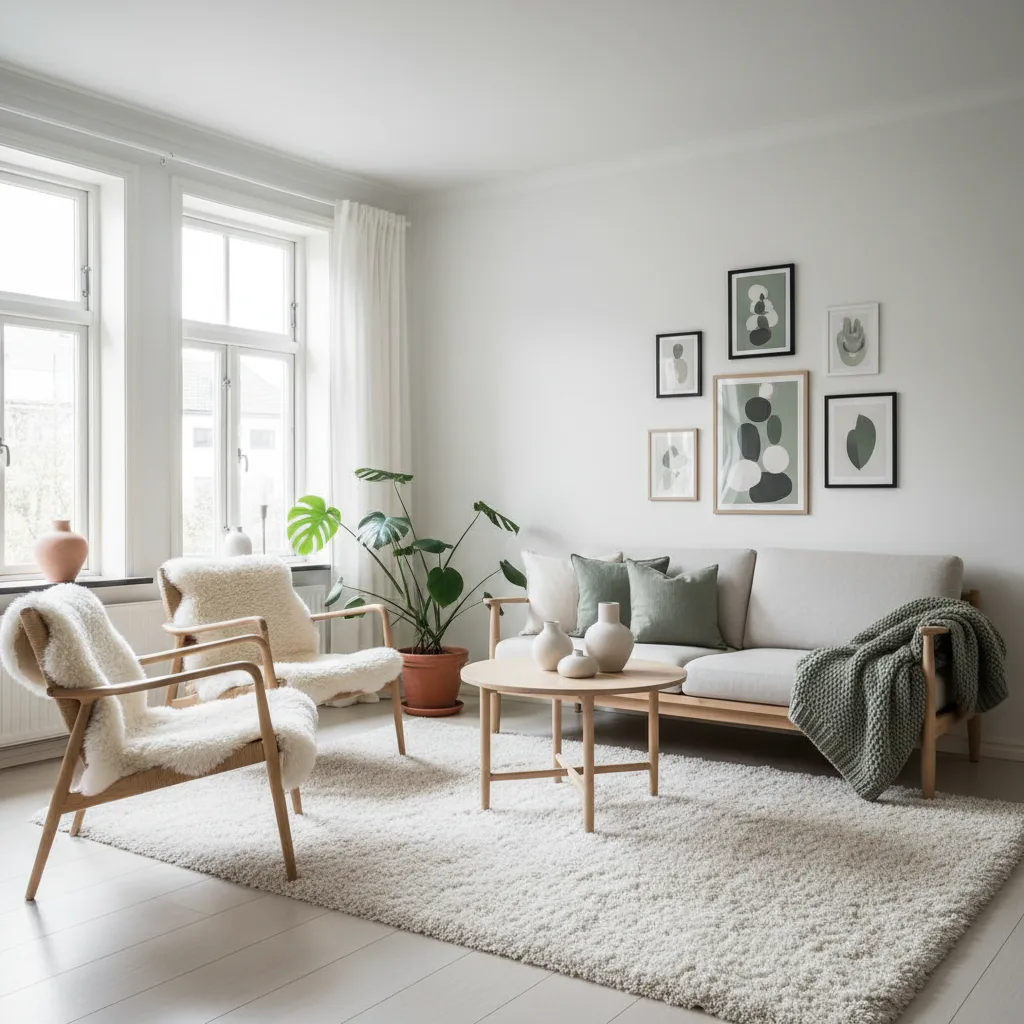
Scandinavian design is warm minimalism — pale wood, white walls, cozy textiles, and plants that make the restraint feel lived-in rather than cold. The defining quality is that it is simultaneously simple and inviting, which is harder to pull off than it looks. Confused with Modern (warmer and softer than Modern) or Japandi (less austere than Japandi). Suits people who want simple but not sterile, who find all-white rooms beautiful in theory and joyless in practice.
Japandi
Japandi merges Scandinavian warmth with Japanese restraint — lower furniture, darker natural wood tones, wabi-sabi objects that embrace imperfection, and a color palette that leans earthy and muted rather than bright and airy. The mood is more serious and grounded than Scandi. Confused with Scandinavian (Japandi is darker and more austere) or Zen (Japandi still cares about furniture and objects; pure Zen is more about emptiness). Suits people who love Scandi but find it a touch too soft.
Mid-Century Modern
Mid-Century Modern draws from a specific era — the 1950s and 1960s — and the markers are precise: tapered hairpin legs, warm walnut wood, organic shapes, and pops of mustard yellow, burnt orange, or teal against a neutral field. It is often lumped under the vague label "retro," but it is not retro in general; it is a specific design language with a specific period. Suits people who like their home to have a clear point of view and don't mind a room that announces itself the moment you walk in.
Traditional
Traditional interiors are built on symmetry, dark wood, rich upholstered fabrics, formal furniture arrangements, and a sense that the room has always looked this way and always will. The word "formal" is not a criticism here — it is the point. Confused with Transitional — Traditional goes all the way and makes no apologies for it. Suits people who grew up with formal dining rooms and feel genuinely at home in spaces that have that settled, established quality.
Transitional
Transitional style occupies the middle lane between Traditional and Modern — the comfort and warmth of traditional furniture softened by cleaner lines and a lighter palette. The test of a well-executed Transitional room is that you cannot place the era, which is precisely the goal. Confused with Traditional (Transitional pulls back from the formality) or Modern (Transitional keeps the comfort). Suits people who want timeless over trendy and are not interested in making a statement.
Farmhouse
Farmhouse style uses rustic materials — shiplap, reclaimed wood, linen, galvanized metal — but keeps them fresh and uncluttered rather than precious or dusty. The critical word is "edited": Farmhouse is not a collection of country antiques, it is a considered use of honest materials. Confused with Rustic (Farmhouse edits aggressively; Rustic does not) or with the maximalist version sometimes called Country. Suits people who want warmth and texture without anything that feels fussy or grandmotherly.
Modern Farmhouse
Modern Farmhouse takes Farmhouse materials and sharpens them with more graphic, contemporary lines — black metal fixtures and hardware, white-on-white contrasts, cleaner furniture silhouettes that replace the softer farmhouse shapes. The result is warmer and more textural than Modern, but more graphic and less cozy than traditional Farmhouse. Confused with Farmhouse (Modern Farmhouse is more architectural and less nostalgic). Suits people who want the aesthetic warmth of Farmhouse without anything that risks feeling dated.
Industrial
Industrial design celebrates exposed structure — brick walls, steel beams, concrete floors, raw leather, and aged wood — with the attitude of a converted urban loft. The key distinction is that it does not disguise the building; it makes the building the decor. Confused with Modern (Industrial is rawer and celebrates imperfection where Modern prefers polish). Suits people who find highly finished, polished spaces a little boring and want a room that feels like it has some history.
Coastal
Coastal style is airy, light-filled, and built on a sandy-to-blue palette with natural fibers like rattan, jute, and linen — but it is subtle about it. There are no anchors on the wall, no rope wrapped around anything. It feels like a deep breath, not a theme park. Confused with Nautical (Coastal is indirect; Nautical leans into the maritime imagery). Suits people who want the room to feel like an exhale and are happy with a palette that revolves around light and air.
Nautical
Nautical style is the more literal cousin of Coastal — navy and white, rope and stripes, lanterns and ship-wheel motifs. It commits to the maritime theme without apologizing for it. Confused with Coastal (Nautical names the theme; Coastal evokes it). Suits people who want no ambiguity about what their room is doing and enjoy the clarity of a fully committed concept.
Bohemian / Boho
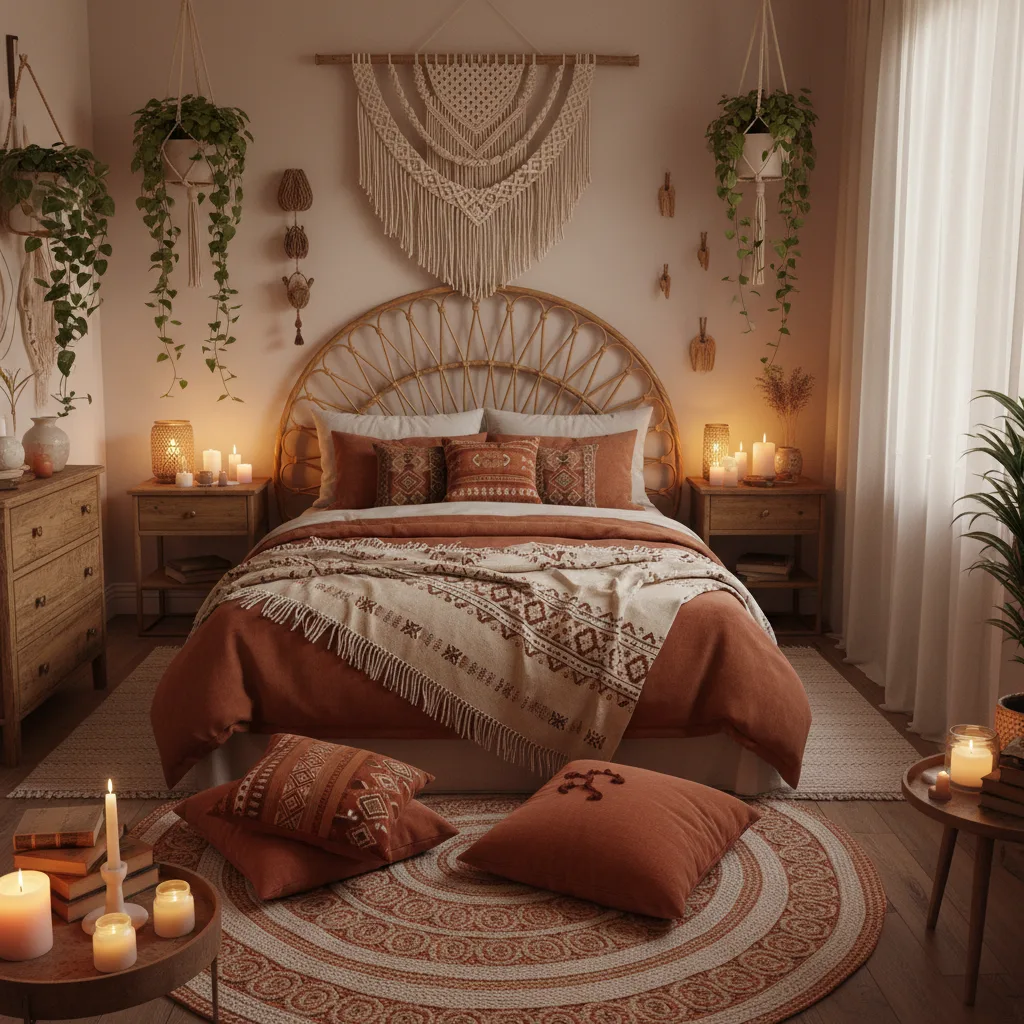
Bohemian style is layered, eclectic, and deliberately anti-minimal — macramé, trailing plants, vintage textiles, kilim rugs, pattern on pattern, objects from different countries and eras all coexisting. The spirit is a free-spirited aesthetic filter: not random accumulation, but accumulation that reflects a life fully lived. Confused with Maximalism (Boho has a specific aesthetic and spiritual register that Maximalism does not require). Suits people whose home is a scrapbook of where they have been and what they love.
Maximalist
Maximalism is deliberate, curated excess — bold color, mixed patterns, gallery walls, collected objects — executed with enough intentionality that "more" is obviously a choice, not a default. The difference between a Maximalist room and clutter is curation and a consistent organizing logic, usually color. Confused with clutter or with Boho (Maximalism has no required aesthetic other than abundance and intention). Suits people who feel muted and hemmed-in by empty rooms and think restraint is overrated.
Glam / Hollywood Regency
Hollywood Regency — also called Glam — is theatrical luxury: velvet upholstery, mirrored surfaces, gold accents, bold jewel tones, high-contrast patterns. It is the interior design equivalent of dressing for an event, not for Tuesday. Confused with Traditional (Glam is theatrical; Traditional is formal and restrained). Suits people who want their home to feel like a production, who find quiet sophistication a little underambitious.
Art Deco
Art Deco is a specific 1920s-1930s design movement, not a general "fancy" aesthetic — the markers are geometric patterns, bold symmetry, gold and black, lacquered surfaces, and a sense of machine-age precision applied to luxury materials. Confused with Glam (Art Deco is historically specific and more graphic; Glam is a looser attitude toward opulence). Suits people who love graphic design in physical form and find the 1920s the last moment architecture had genuine optimism.
Zen / Wabi-Sabi
Zen / Wabi-Sabi treats imperfection as beauty — rough textures, asymmetry, hand-thrown ceramics, natural stone, a muted earthy palette in which nothing is too smooth, too perfect, or too symmetrical. Where Japandi cares about furniture and composition, Wabi-Sabi is more about the objects themselves and what they communicate about impermanence. Confused with Japandi (Zen is less about furniture arrangement, more about the nature of individual objects). Suits people who find perfectly styled rooms exhausting and feel calmer around things that look handmade.
Mediterranean
Mediterranean interiors are warm and earthy — terracotta floors, arched doorways, hand-painted tile accents, wrought iron details, whitewashed walls that glow in warm light. The reference points are Santorini, Tuscany, and coastal Morocco rather than anything Scandinavian or Northern European. Confused with Coastal (Mediterranean is warmer, earthier, and more architectural; Coastal is lighter and airier). Suits people who want the room to feel sun-warmed and specific to a place, not generic-vacation-rental airy.
Eclectic
Eclectic is intentionally mixed — different styles, eras, and origins held together by a consistent color story or material thread that makes the whole room feel deliberate rather than accidental. The operative word is "intentional." Confused with "I couldn't decide" — Eclectic is a choice made by someone who knows exactly what they're doing; a default mixed room is just a mixed room. Suits confident decorators who know the rules well enough to know when to break them.
Rustic
Rustic style means raw, natural, and unpolished — exposed wood beams, stone walls, linen and leather in their most natural state, with no attempt to refine or smooth the materials into something more finished. Farmhouse edits; Rustic does not. Confused with Farmhouse (Rustic is less curated and more willing to let rough materials dominate without any contemporary counterbalance). Suits people who want the room to feel genuinely like a cabin, not a cabin aesthetic applied to a suburban house.
The Pairs People Confuse Most (and How to Tell Them Apart)
- Modern vs. Contemporary. Modern is a fixed historical aesthetic from the mid-20th century: clean lines, no ornamentation, specific material palette. Contemporary just means "current right now" and changes with each decade. A Contemporary room in 2026 borrows from several styles; a Modern room always looks like 1958.
- Scandinavian vs. Japandi. Both use natural wood and controlled palettes, but Scandi is brighter, softer, and cozier. Japandi is darker, lower to the ground, more austere, and deliberately closer to the Japanese concept of restraint than to Nordic coziness.
- Farmhouse vs. Modern Farmhouse. Both use shiplap, wood, and linen. Modern Farmhouse adds black metal hardware, sharper furniture lines, and a more graphic contrast between white and wood that reads more architectural than cozy.
- Coastal vs. Nautical. Coastal evokes the sea through palette, texture, and light without naming the theme directly. Nautical names it: stripes, navy, rope, anchors. Same source material, completely different levels of commitment.
- Boho vs. Maximalist. Boho is a specific free-spirit aesthetic with a global, collected, nature-forward filter. Maximalism is a broader philosophy about deliberate abundance, which can look like Boho but can also look like a bold-color Art Deco or a jewel-tone Glam room.
- Rustic vs. Industrial. Both like raw materials, but Rustic is purely natural — wood, stone, linen, leather — and rural in reference. Industrial is urban in reference and adds manufactured materials: exposed steel, concrete, and metal ductwork.
How to Find Your Style (Without a Quiz)
Style quizzes ask how you feel about adjectives like "cozy" and "bold." The problem is that your reaction to an adjective has almost nothing to do with your reaction to your actual room in that style. The faster method: from this guide, pick the three styles that stopped you. Not the ones you think you should like — the ones that actually made you pause. Then upload a photo of your room to Revamp AI and apply each of those three styles to it.
Your gut reaction to seeing your own room — your actual ceiling height, your actual window, your actual awkward corner — in each style will tell you more in ten seconds than any quiz can tell you in ten minutes. One will feel right. One will feel like a stranger's house. One will feel close but not quite. Those three reactions are your answer.
Style quizzes ask what you like in theory. The only question that matters is: does this look right in my room? AI answers that question first.
If you are redesigning a specific room, the guides on AI living room redesign, AI bedroom design, and AI kitchen redesign go deeper on what each style actually does in those spaces — the specific furniture choices, palette shifts, and layout decisions that translate a style name into a liveable room.
Experimente grátis com a Revamp AI
Further reading: AI Living Room Redesign · AI Bedroom Design App · AI Kitchen Redesign
Perguntas comuns
Perguntas frequentes
Japandi and Modern Farmhouse are consistently among the most searched interior design styles in 2025-2026. Japandi in particular has grown significantly because it offers the calm of Minimalism with more warmth and personality. Transitional remains the single most common style in professionally designed homes because it reads as timeless rather than trend-driven.
Skip the personality quiz. Instead, use this guide to identify two or three styles that genuinely stop you — not the ones you think you should like. Then apply each to a photo of your actual room using an AI design app. Your gut reaction to seeing your own space in each style is more reliable than any abstract question about whether you prefer "cozy" or "bold."
Yes, and most successful rooms do. The key is having one dominant style that sets the bones of the room and one secondary style that adds interest — for example, Japandi structure with a Wabi-Sabi approach to objects, or Modern lines with a Bohemian textile layer. What holds it together is usually a consistent color story. The Eclectic style is literally defined as intentional mixing.
Scandinavian is often the most accessible starting point. The palette is forgiving (white, pale wood, soft textiles), the furniture is widely available at most price points, and the style tolerates imperfection well — a few plants and a chunky throw go a long way. Industrial is also achievable if you are renting, because it works with exposed architecture you already have rather than requiring new furniture.
Modern refers to a specific mid-20th century design movement — roughly the 1930s through 1970s — characterized by clean lines, functional forms, and specific materials like walnut, chrome, and leather. Contemporary simply means "current right now" and reflects whatever is trending in design at this moment. A Modern room always looks like a specific era; a Contemporary room looks like it was designed recently, but that definition shifts every decade.